The court ruled, SFC fired back, and Linus couldn’t resist weighing in. Here’s what actually happened.
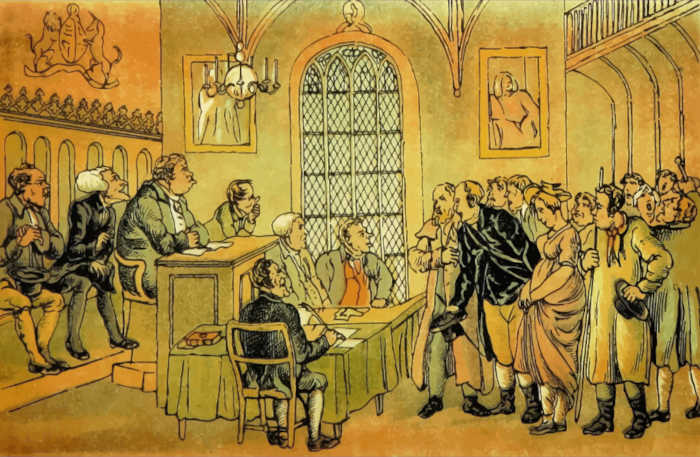
The lady who needs to be on a diet hasn’t sung yet — meaning the case isn’t yet over — but the judge hearing the case brought by the Software Freedom Conservancy against low‑cost flat panel TV maker Vizio has issued another ruling. This time she clarifies the court’s position on an issue that isn’t in dispute.
As we reported on December 5, SFC has taken Vizio to court for failing to make the source code available for GPLv2 and LGPLv2.1 licensed software that runs in its SmartCast TVs.
In a tentative ruling issued December 4, California Superior Court Judge Sandy N. Leal said that SFC was likely to win. That ruling came ahead of a December 5 hearing that SFC’s executive director Karen M. Sandler told FOSS Force in an email “went well.” As expected, she said, “Vizio stridently disagreed” with the judge’s tentative analysis.
“Our lawyer who was the primary person speaking on our behalf, David Schultz, rebutted Vizio’s points and (we think successfully) demonstrated why the tentative ruling was rightly issued.”
Sandler said that Judge Leal indicated that she expects to issue her ruling on this, as well as on Vizio’s motion for summary adjudication, by “the holidays.”
Judge Leal’s Latest Ruling
On December 23, another ruling was issued by Judge Leal that doesn’t bring the case to a conclusion, but does handily deal with the “summary adjudication” part — which is legalese for a ruling that covers specific claims, defenses, or issues without a full trial because there is no genuine dispute of material fact on those points.

In this case, the judge ruled that Vizio isn’t required to provide source code that can be compiled and installed as a drop-in replacement for the code that ships with its SmartCast TVs. That’s an important point for Vizio, because its TVs ship with a software brew that includes Linux, BusyBox, and other open source software, as well as Vizio’s own proprietary software.
“Read as a whole, the Agreements require Vizio to make the source code available in such a manner that the source code can be readily obtained and modified by Plaintiff or other third parties. While source code is defined to include ‘the scripts used to control compilation and installation,’ this does not mean that Vizio must allow users to reinstall the software, modified or otherwise, back onto its smart TVs in a manner that preserves all features of the original program and/or ensures the smart TVs continue to function properly. Rather, in the context of the Agreements, the disputed language means that Vizio must provide the source code in a manner that allows the source code to be obtained and revised by Plaintiff or others for use in other applications.”
When reporting on the ruling the next day, SFC stressed that they think that Vizio’s motion was misleading:
“SFC has never held the position, nor do we today hold the position, that any version of the GPL (even including GPLv3!) requires ‘that the device continues to function properly’ after a user installs their modified version of the copyleft components.”
“Unfortunately, Vizio’s motion is likely to confuse the public. No reasonable consumer or copyleft activist has ever asked for this, nor expects it. GPLv3 itself even allows (under certain conditions) for the OEM vendor to cause the accompanying user-space proprietary software to cease to function. We frankly don’t know where Vizio got the language for their motion.”
Torvalds Jumps In
Evidently Linus Torvalds didn’t see SFC’s post, because the next day he weighed in with his own post supporting the judges ruling, and erroneously placing blame on SFC:
“The court case itself is a mess of two bad parties: Vizio and the SFC. Both of them look horribly bad in court – for different reasons.
“Vizio used Linux in their TVs without originally making the source code available, and that was obviously not ok.
“And the Software Freedom Conservancy then tries to make the argument that the license forces you to make your installation keys etc available, even though that is not the case, and the reason why the kernel is very much GPLv2 only. The people involved know that very well, but have argued otherwise in court.
“End result: both parties have acted badly. But at least Vizio did fix their behavior, even if it apparently took this lawsuit to do so. I can’t say the same about the SFC.
“Please, SFC – stop using the kernel for your bogus legal arguments where you try to expand the GPLv2 to be something it isn’t. You just look like a bunch of incompetent a**holes.”

Christine Hall has been a journalist since 1971. In 2001, she began writing a weekly consumer computer column and started covering Linux and FOSS in 2002 after making the switch to GNU/Linux. Follow her on Twitter: @BrideOfLinux