As US legal reach over cloud data keeps spooking EU regulators and customers, SUSE is betting that pairing its software with up‑and‑coming European providers like Evroc will give it an edge over US‑based rivals.

SUSE continues to make inroads in Europe’s increasingly important digital sovereignty arena. The Germany- and Luxembourg-based Linux solutions company announced Tuesday that it has partnered with Evroc, a European public cloud company that’s positioning itself as a sovereign cloud platform, to make SUSE Linux Enterprise, as well as SUSE Linux Micro — a miniaturized version of Linux commonly used in containers as a base image — available to be spun up on Evroc’s cloud infrastructure.
In addition, the two companies have worked together to certify that SUSE Rancher Prime performs well on Evroc’s infrastructure, meaning that SUSE’s entire cloud-native stack is production ready for use on Evroc’s digital sovereignty-focused cloud.
“We are delighted to partner with SUSE to bring a comprehensive and sovereign cloud offering to the European market,” James Collis, VP of Partnerships at Evroc, said in a statement. “SUSE’s proven expertise in enterprise open source, combined with Evroc’s advanced cloud infrastructure, will provide an unparalleled solution for organisations seeking control and security over their digital assets.”
Continental Digital Sovereignty
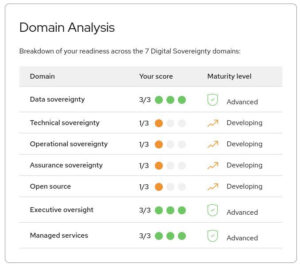
Under the banner of “digital sovereignty,” Europe has increasingly tried to wrest more control of its digital infrastructure away from US tech giants, in a way that echoes some of the same concerns that motivated the free software movement in the days of Gates and Ballmer. The use of the word “sovereignty” is key, as the United States increasingly seeks to extend its judicial reach to data — whether at rest or in transit — on servers controlled by US-headquartered corporations, even when located outside the US. This has complicated the EU’s efforts to protect its citizens’ digital rights.
It has also cast serious doubt on promises made by US-based public cloud providers that data will remain wholly within the country where it’s collected, since a single U.S. government subpoena can ultimately compel them to make the data available in the US. This has created an opportunity for European entrepreneurs and software vendors, as public- and private-sector entities across the region seek to build a digital infrastructure that is not subject to outside interference.

Evroc on the Rise
Stockholm-based Evroc isn’t yet a well-known name — not even in the data center world — outside of Europe. It’s a cloud startup that was founded in 2022. Currently, it doesn’t operate any data centers of its own, but runs its services from colocation space in facilities in Stockholm, Paris, and Frankfurt.
However, it does have a large 50 MW facility under construction at Arlandastad, a planned commercial and logistics area close to Stockholm’s Arlanda Airport, which is scheduled to be operational in 2026. It’s also developing a data center project near Cannes in southern France.
The company is one of a new breed of tech company arising on the continent that has digital sovereignty in its genes. Its stated mandate is to build “Europe’s first secure, sovereign, and sustainable hyperscale cloud,” which will include a full stack of cloud and AI services for sectors with sensitive workloads, such as government, defense, finance, healthcare, and critical infrastructure.
Having SUSE on board lends credibility Evroc’s vision.
“This partnership with evroc is a significant step forward in our commitment to providing a choice of open, interoperable, and secure solutions for our customers,” SUSE’s chief strategy officer, Frank Feldman, said in a statement. “Together, we are building a truly European cloud ecosystem that empowers businesses with digital sovereignty and the flexibility they need to innovate.”
SUSE Puts Digital Sovereignty Up Front
We’re likely to see more deals like this from SUSE in 2026. The company seems to recognize that its location within the EU — and its status as large independent open source company with a 33 year history — potentially gives it a meaningful advantage over its larger competitor Red Hat, which is located in the US and tied to big tech through its ownership by IBM.
In July SUSE introduced Sovereign Premium Support to help companies navigate digital sovereignty regulations imposed continent-wide by the EU and locally by member countries. Among other things, the service provides EU-based Service Delivery Managers and Premium Support Engineers, and that support data is stored on EU-located networks and servers. Included is a commitment to meet encryption requirements for data needed for troubleshooting.
Evidently Red Hat has been paying attention to what SUSE is doing in Europe. In November it announced a similar program — Red Hat Confirmed Sovereign Support — which will be available in early 2026.
European-based partnerships with companies such as Evroc will serve to strengthen SUSE’s hand.

Christine Hall has been a journalist since 1971. In 2001, she began writing a weekly consumer computer column and started covering Linux and FOSS in 2002 after making the switch to GNU/Linux. Follow her on Twitter: @BrideOfLinux