
Last updated on January 28, 2026
Nearly seven years after Richard Stallman left MIT under pressure and resigned the presidency of the Free Software Foundation he founded, he’s back on a U.S. campus giving a talk that is pure RMS — and fundraising for FSF in the process.

On Friday, Richard Stallman gave a talk at Georgia Tech, his first public appearance at a US university since his cancer diagnosis and recovery. It’s also one of a very few appearances he’s made since his fall from grace nearly seven years ago. Although he’s given a few talks in the EU during that period, they’ve largely been ignored by the press. The one exception — besides FOSS Force that is — would be the FLOSS and FOSS-focused Techrights, which never quit supporting him.
You might remember that in 2019, Stallman made comments that were widely seen as defending abusers in the Jeffrey Epstein sex trafficking case. This created a public backlash that led to his resignation from MIT, as well as from the Free Software Foundation which he founded. That would likely be ancient history to the students who made up the audience at Friday’s event, many of whom would’ve been in middle school or barely in high school at the time.
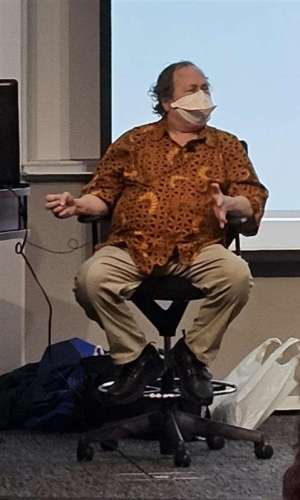
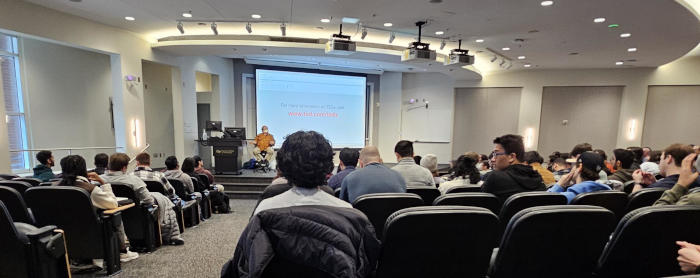
The event was organized by LibreTech Collective, an open-focused Georgia Tech student organization, and took place at Georgia Tech’s Scheller College of Business
The World According to Stallman 101
What struck me the most when I watched the video of the presentation (two versions have been posted online — one on YouTube and one on Vimeo), was how much Stallman’s viewpoints have remained the same. It was much as if he was just picking up where he left off. Even when he was covering new territory — such as when he discussed generative and agentic AI, which were hardly things in 2019 — his answers were pretty much exactly what you would anticipate from Stallman.
The entire presentation ran for nearly 2 1/2 hours, and included a prepared talk, and was followed by a long Q&A session before finishing up with a pitch for FSF’s current membership drive, and a brief auction for FSF. The talk — which is mainly what people came for, I’m guessing — started with a video recording of a previous TED talk by Stallman, which hit a lot of the high points he intended to cover during the presentation. After that, it was all live Richard Stallman at Georgia Tech all the way.

Greatest Hits… With Bonus Tracks
Because of the changed landscape since Stallman was last a daily part of the free tech landscape, his talk on Friday was kinda like one of those reissues of a “Best of” album that contains a few new “bonus tracks” to appeal to those who already own a copy of the original album. Here are lightly edited and abridged versions of the first five subjects Stallman touched on during his Georgia Tech appearance:
- The Importance of Reverse Engineering: “Universities should teach students to do reverse engineering, and should help them focus on the projects that will remove obstacles to winning freedom. For instance, peripherals for various computer models and for ‘snoop phones’ [a term he sometimes uses to describe cell phones, which he considers to be “surveillance devices”] are obstacles to running free software, software to replace the nonfree systems that they normally come with. Reverse engineering is the path by which we can overcome obstacles like that.”
- The Power of Copyleft: “Every work that is written is automatically copyrighted. That is a consequence of a harmful treaty called the Berne Convention, which the United States was pressured into signing around 1980. As a result, lots of things nobody ever particularly wanted to monopolize or restrict are restricted by default. I could write a program and write on it, ‘I Richard Stallman say you can do whatever you want with this code.’ It would be free software that way — at least my version would be — but anybody else could make a modified version and then have a copyright on those changes, and by default, that version would not be free.
“I didn’t want my free software to have to compete with everybody’s improved version of my own code, so I figured out a way to use copyright law to prevent that. I drew up a statement of copyright permission. I release a program. I say, copyright Richard Stallman or copyright Free Software Foundation.’ I don’t just say you can do whatever you like with this; I say you’re free to run this, to make modified versions, to redistribute exact copies, and redistribute your modified versions — the four freedoms. But there are conditions on redistribution. When you redistribute a copy that is modified, you must put the same permissions on your modifications.
“In other words, your modified version must be free in the same way — free and copyrighted. This way, everybody’s free to make modified versions and release them, but those have to be free also.”
- Artificial Intelligence Isn’t: “Intelligence is the capacity to know and understand, at least within some domains. If it could know and understand all sorts of things that people can, then it would be a human level intelligence. There can be lower levels of intelligence than that, which are nonetheless intelligence, but nowadays people often use the term artificial intelligence for things that aren’t intelligent at all.
“…That’s where we find this buzzword being promoted the most — for large language models [which are] bullshit generators, because they don’t know anything. They generate text and they don’t understand what that text means. They don’t notice if their algorithm produced text that is simply mistaken. They do that without batting a virtual eyelash, so you can’t trust anything that they generate.
“I decided not to be part of their campaign to convince people that those things are intelligent. Every time you call them, AI, you are endorsing the claim that they are intelligence and they’re not. So, let’s refuse to do that. I’ve come up with the term ‘pretend intelligence.’ We can call it PI. So, if the system can really understand statements in some domain, maybe it’s real artificial intelligence within that domain, but if it can’t, then it’s pretend intelligence.”
- The Pressure to Be Non-Free: “In the past decade or so, we have seen intense pressure on people to run nonfree programs. Some businesses won’t deal with you unless you run nonfree software. I’ve noticed for many years that I can’t use airline websites. They try to send nonfree software to run in my browser, and I won’t. My browser won’t let that run, so those pages don’t work. If I want to get an airline ticket, I phone the company. That’s the only way I can do it. There are even governmental websites that won’t talk to you unless you run nonfree software. Well, I won’t let anything pressure me like that.
“It was around 1996 that GNU plus Linux was running smoothly enough — and handled the peripherals in our computers — that we could actually install it there. So we put GNU/Linux into all our computers and we had no nonfree software in them, and this was our day of our escape. I was determined that this escape be permanent, so ever since then, anytime someone suggested — or even worse, tried to insist — that we run any piece of nonfree software, I swear that is trying to spoil the liberation that we have won with hard work, and my response is no. Whatever convenience you’re offering us or whatever work it takes to refuse, we won’t do that.
“I’m still refusing to backslide and this is extremely important. It’s not just a matter of how I feel — although I hope you will learn to feel it too — it’s a matter of maintaining the freedom that we have won rather than letting it go. There’s a lot of pressure, which you’ve already encountered, to surrender it.”
- Don’t Be a Lemming: “Many of you probably are used by antisocial media. I never have been. When I found out what was going on, I was sort of disgusted by it and I objected to the fact, for instance, that Facebook required people to give their real names. You shouldn’t do that to people. Tracking and identifying people is the platform for repression, and we can see that repression happening now in this country. So, I was always against it, even before you had to run nonfree software to use it.
“Most people are pressured into doing that without even thinking of these moral questions, and that’s because it is a very widely used communications mechanism. If I set up a system for people to communicate with each other and five people are using it, you probably wouldn’t feel much pressure to start using it too. But when, say, 500 million people are using it, you might feel pressure. You might feel I can’t refuse that; I have to surrender; it’s a shame, but I’ll get used to it.
“The problem is, once you give in like this, you become part of the problem. This is called the network effect. The more people use a particular communication system, the more attractive it is to others, but that attraction can be seen as a pressure as well — it just depends on your point of view.
“Most people think it’s impossible to refuse. I refuse. I’m really firm, no matter what reason there might be for me to start using that nonfree system. It’s not worth the feeling of defeat I would feel from having surrendered. So I just keep refusing and keep refusing and keep refusing. I look for ways to talk people working around it.”

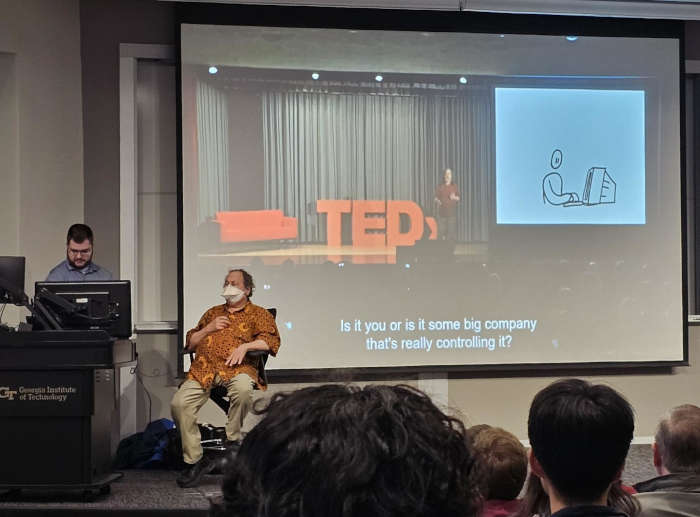
Those weren’t the only subjects Stallman covered. There were plenty of others drawn from the bag of Stallman’s greatest hits, such as his take on educational institutions forcing nonfree software on students (he called out Georgia Tech for handing out Microsoft accounts to students), nonfree software as malware (which took up much more time than anything else), and how open source isn’t really free (unless it’s copyleft, that is).
Actually, my interpretation of the last point — his take on open source — was off the mark, as I explain in the update at the end of this article.
After his talk, there was more. Much, much more.
The long Q&A that followed largely drilled deeper into subjects that Stallman had already covered in his talk, plus drifted off into other pertinent subjects, such as Stallman’s favorite Linux distributions (hint: the ones that don’t ship with nonfree software).
Stallman, the FSF, and the Future
During the talk, Stallman spent more than a little time talking about FSF’s current membership drive, and his conversation was peppered with mentions of FSF — both during his talk/lecture and during the Q&A session that followed, indicating that in addition to being an FSF board member, Stallman is still very much a part of FSF’s continuing operations, which hasn’t always seemed to be the case in recent years.
At one point he was asked about the events that led up to his resignation at FSF and MIT, which he fielded gracefully and called a misunderstanding. Truthfully, it looks as if Stallman’s exile is over and the public is generally willing to accept that Stallman was largely pushed from public life by ill conceived and misunderstood statements by Stallman.
Through the grapevine, I’m hearing that we’re likely to see more from Stallman in the future. I’m sure that will be to the chagrin of some and the delight of others.
Update 1/28/2026: About my faux pas on Stallman’s position on open source:

On Tuesday, or the day after this article was published, I received a nice email from Stallman that politely pointed out that my take on his take on open source — as opposed to Free Software — was wrong.
“Nearly all open source programs are free/libre,” he wrote. “The widely used open source licenses are in fact free/libre licenses. That includes the widely used copyleft licenses and the widely used weak licenses.
“There are open source programs that are nonfree, but they are unusual exceptions. There are also free programs that are not open source, but they too are unusual exceptions.”
He went on to point me to his article “Why Open Source Misses the Point of Free Software.”


Christine Hall has been a journalist since 1971. In 2001, she began writing a weekly consumer computer column and started covering Linux and FOSS in 2002 after making the switch to GNU/Linux. Follow her on Twitter: @BrideOfLinux


Thank you for this recap of RMS’s talk. I, for one, will be glad to hear more from him!
Great to see him speak about today’s tech. In a world full of vague and weasel-like ToSes, Mission Statements and “Privacy” pages – I like the precision of his words.
It was a good read, Ill have to watch the video. I support Richard and all he stands for. Freedom my friends. Liberation. (Written on Windows 11, about to switch back over, just needed a little inspiration.