
NCZ-OS begins as a Linux answer for new CIX Sky1 Arm systems, with plans down the line for T2-equipped Intel Macs and capable PCs that can’t officially upgrade to Windows 11.
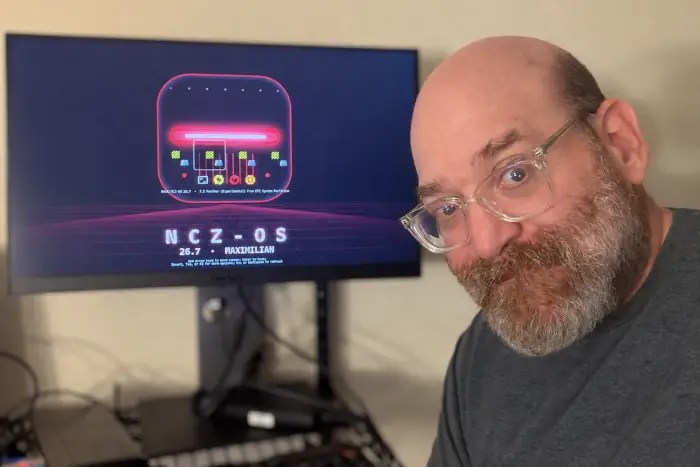
What would you do if you bought some capable hardware that you really like, but there’s no Linux distribution that runs well on it?
When Jason Perlow found himself in that predicament, he broke out some tools and built his own Linux distribution to fully support it. He’s calling the distro NCZ-OS, and it currently supports arm64 machines, with a specific focus on the CIX Sky1 platform, targeting Radxa Orion O6/O6N and Minisforum MS-R1 devices. Support for OrangePi systems is currently under validation.
He’s not stopping there. He’s now working on getting it to work on some older hardware that’s been stranded by Microsoft and Apple.
If Perlow’s name seems familiar, there’s a reason for that. For years his byline graced articles on sites such as CNN, Linux Magazine, ZDNet, and others. He’s also spent stints as an employee at the Linux Foundation, Microsoft, and IBM. Some of you might also know him for his foodie videos.
“I think the story here is interesting because I have heavily used AI pair-programming tools (Codex, Claude, OpenCode/Goose/Pi) to put this distro together, along with Yocto as the build system,” he told me in a conversation that took place via email. “This would have been basically impossible for a single person to do five years ago.”
Making Linux Safe for Arm CIX Sky1
In some ways the project harkens back to the 1990s, when coders were working to build GNU/Linux distributions that would work on whatever hardware they had laying around and needed to get it to work on.

“I bought a Sky1-based system,” Perlow said. “It was an attractive piece of hardware for $600 — 64GB RAM, 12 cores, GPU, and NPU. When it arrived, a lot of stuff wasn’t working out of the box. I decided to keep it and not return it, and see if I could get it to do as advertised. I now own two (Minisforum, Radxa) with a third on the way (OrangePi).”
NCZ-OS originally used an Ubuntu base, but now starts with the arm64 port of Debian testing (forky). It uses a customized Debian installer with a bit of built-in failsafe: the base system is installed directly from the image, doing away with issues, like maybe an iffy network connection or unreachable mirror.
“The goal is specific: make the SoC’s accelerators work under a current kernel and a fully Wayland desktop,” he said. “On new Arm silicon the accelerators are usually the last thing to work and often the thing that never does, with the GPU falling back to software and the NPU and video engine present only as device nodes nothing can drive. Closing that gap is the point of the project.”
There have been numerous workarounds necessary to get the OS working to his liking. That’s not surprising. According to Perlow, the CIX Sky1 is not only new technology, it was apparently initially designed for China’s domestic smartphone market, so architecturally it has more in common with a phone-class system-on-chip than a conventional PC. Although it’s supported by some other distros, the support is incomplete.

“NCZ-OS is not the only option and I would not want to suggest otherwise,” he said. “Armbian maintains a CIX board family, Radxa publish Debian and Fedora images for the Orion O6, Ubuntu has a concept image, and CIX publishes an SDK and is upstreaming core SoC support, which matters more in the long run than any downstream image. A community project, Sky1-Linux, assembled kernel and GPU packaging and drew genuine interest, though its repositories have had no activity since March 2026.
“What differs here is the scope of what is made to work on one image, and the practice of measuring each claim on hardware before making it,” he added.

Making Mac-tel x86 Whole
Perlow isn’t stopping with NCZ-OS as a specialized Arm distro. He’s working on a specialized x86 version too.
“The x86 target is deliberate rather than opportunistic, and it is the one I care most about,” he said.
He’s attacking x86 on two fronts, starting with enabling full desktop support for older Macs that were built before Apple said goodbye to Intel and x86 in 2020.

“I have been a committed Mac user since leaving Microsoft in 2017, and none of the Linux desktops I’ve used since then has given me a compelling reason to switch,” he said. “I own an Intel Mac from 2020 which is largely abandonware, with the exception of the T2 kernel being developed [a Linux kernel with patches or drivers for T2-equipped Macs], but there is no distribution that really is tuned for it. They all kind of stop at the kernel and are the same Ubuntu or Arch or whatever distro experience everyone else gets.”

“That’s not a bad thing necessarily,” he added, “but I think you need a compelling reason for end users with older systems to switch to Linux more than ‘my abandoned hardware now works.’ That doesn’t pull millions of systems necessarily out of the e-waste pile.”
Mac branded x86 machines that were manufactured in the years leading up to Apple’s change to its own chip design are still capable today, Perlow pointed out, but they need a specific kernel patch series to make the keyboard, trackpad, audio, and networking work.
“That series exists and is maintained by the t2linux community,” Perlow said. “Carrying such a series on a current base is the same task this project already performs for Sky1, which is why it is a realistic target rather than a wish.”
A Wintel 10 Lifejacket Too…
There’s more in Perlow’s sights than specialized Arm and old Apples.
“I also have several Windows 10 laptops that are perfectly good but also abandonware — right now they are servers, I don’t like the Linux desktops that exist today. I want to develop a fully modernized distribution that is open source but also delivers an end user experience that doesn’t compromise and ‘just works.'”
“The Steve Jobs approach,” he added. “That’s a very lofty thing for one person to try to do. I’m no Google — but I’m arrogant and motivated…”
He’s talking, of course, about Windows 10 machines with modern specs that couldn’t make Microsoft’s cut for the upgrade path to Windows 11. Official support for Windows 10 from Redmond ended last October, although in some cases extended support remains available through October 2027.
NCZ-OS’s desktop environment is Singularity, which is not a Windows clone by any stretch, but offers a conventional layout that won’t confuse Windows (or Mac) users. It’s from Italy-based Mirko Brombin, whose tech resume checks multiple boxes, including UI/UX designer, open-source developer, and Linux project founder. He’s probably best known as the creator of the popular Wine front end, Bottles, and the Debian-based Linux distribution Vanilla OS.
For the x86 version, Perlow said he intends to use the same Debian Forky base, installer, and Singularity Wayland desktop, paired with a Yocto-built Linux 7.2 kernel.
“The initial targets include T2-equipped Intel Macs from 2017-2023 and capable Windows 10 systems that cannot officially move to Windows 11,” he said. “The goal is the same on both Arm and x86: support as much hardware acceleration as possible and deliver a modern, cohesive experience rather than merely making abandoned hardware boot Linux. I expect the x86 work to be easier, although hardware has a habit of punishing statements like that.”
Release information and downloads are available on GitHub.

Christine Hall has been a journalist since 1971. In 2001, she began writing a weekly consumer computer column and started covering Linux and FOSS in 2002 after making the switch to GNU/Linux. Follow her on Twitter: @BrideOfLinux


