
As Nextcloud increasingly positions itself as a software platform, its new Academy aims to bring more developers into the fold.
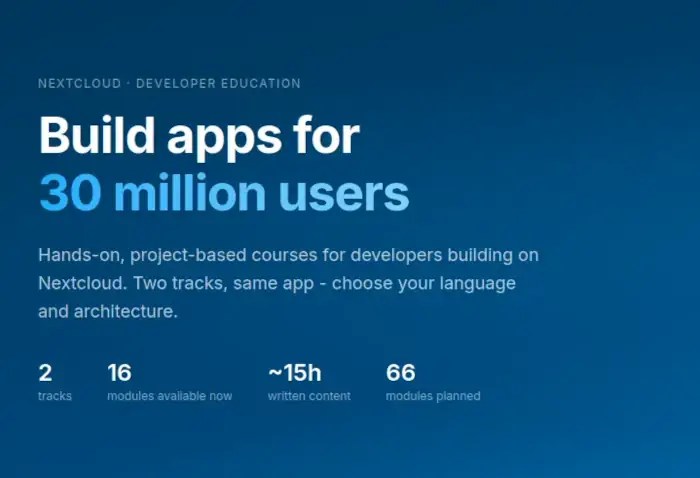
Nextcloud has announced the launch of Nextcloud Academy for app developers who want to create apps for the host-it-yourself cloud platform. The plan is for it to provide hands-on courses for beginners as well as more experienced Nextcloud developers. Right now, modules for beginners are up and ready, with Intermediate and Advanced tracks “coming soon.”
Although officially released on Thursday, Nextcloud Academy was originally previewed on September 16 at the launch of Nextcloud Hub 26 Summer — the latest and greatest release of the organization’s flagship product — and again at the annual Nextcloud Community Conference in Berlin on September 19. Currently it’s being presented as beta, with the caveat that its content may still change.
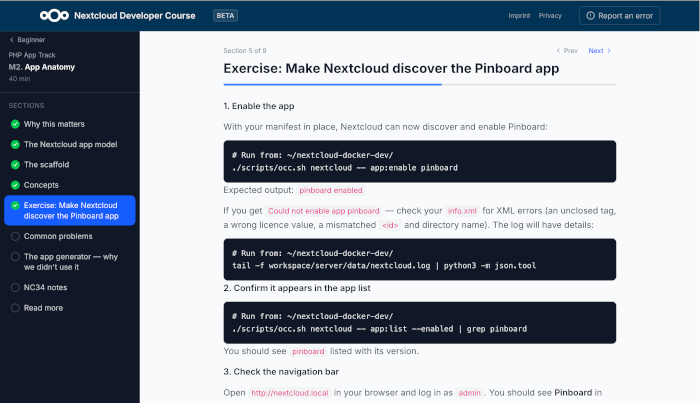
As it now stands it includes two parallel tracks with step-by-step instructions for building the same app with different architectures. The PHP track explains building a classic Nextcloud app that runs inside the server, using controllers, the OCP API, QBMapper, and migrations. The Python ExApp track takes users through the steps to build an external app that runs as a separate Docker service through AppAPI, using FastAPI, nc_py_api, and its own SQLite/Postgres database.
There was already a Beginners Guide to cover the basics of the basics — in other words, how Nextcloud works and the areas “where developers most often get tripped up when their code leaves their local test instance.”
Nextcloud’s Foundational Growth
It’s been a long while since Nextcloud was primarily a self-hosted and open source Dropbox alternative for file sharing. These days it’s a way for enterprises small and large — as well as tech savvy individuals and families — to build self-hosted collaborative portals that include everything from online office suites (which can also work locally), calendars, email, video conferencing, and even a built-in AI assistant.
Over time a large community of developers has also formed around the project, some to build apps specifically for Nextcloud that can be monetized through the project’s app store, or to build custom apps for companies using the platform for employee- or customer-facing portals.
“Nextcloud turns more and more into a software platform,” Frank Karlitschek, Nextcloud’s CEO and co-founder said at the Nextcloud Hub 26 Summer launch event. “For example, at the beginning of the year we had about 500 third-party apps in Nextcloud. Now we’ve surpassed 800 and it’s only September, so it’s really amazing what the community is doing.”
While growing the number of apps available for the platform is obviously important for Nextcloud — and for the EU’s digital sovereignty efforts — it’s also recently been becoming a way for developers to monetize their cloud-bound efforts. For the last year or so, the platform has allowed developers to seek donations through its App Store, which Nextcloud has indicated is paying off for some developers.
Nextcloud Academy should help not only developers’ monetization efforts, but more importantly, make it possible for small developers to bring apps that are currently tied to running locally on users’ hardware to the cloud.
A Milestone Year
The new program is only a bit of icing on the cake for the Germany-based project, which is in the midst of something of a banner year. All year long, the organization has been celebrating 2026 as the 10th Anniversary of its fork from ownCloud. Again, during that time it’s gone from being a Dropbox wannabe with promise to a full-featured self-hosted cloud platform.

It also appears to be one of the principal beneficiaries of the EU’s sovereignty efforts, being that it’s become the easiest way to swap-out proprietary cloud platforms from overseas with a product that’s not only wide in scope and just works, but is also European homegrown, and free and open.
The latter — free and open — might be the most important. That’s what guarantees governments and enterprises alike that the software will not suddenly get pulled out from underneath them.
Oh, and the growing amount of software that’s available to Nextcloud users doesn’t hurt.
“Sometimes I’m browsing through the app store and it’s really so cool to see what is happening,” Karlitschek said. “For example, there are bookkeeping apps, there are time tracking apps, content management systems, and even full CRM systems. Of course, there is also cool stuff from the community, for example applications to manage your movie database or your music collection.”

Christine Hall has been a journalist since 1971. In 2001, she began writing a weekly consumer computer column and started covering Linux and FOSS in 2002 after making the switch to GNU/Linux. Follow her on Twitter: @BrideOfLinux


Be First to Comment