Sometimes you have to quit cleaning your code long enough to clean your room. The people at the FreeBSD Foundation have already been doing some spring cleaning. They’ve even called the decorator.
Drumroll, maestro…
**If you’re finding this article useful, please consider helping us meet our absolute minimum daily goal of $16.29 so our FOSS Force Independence 2026 fundraiser stays on track.**
There’s a new look at the FreeBSD Foundation, with a new logo and website. The changes are intended to highlight “the ongoing evolution of the Foundation identity and ability to better serve the FreeBSD Project,” according to the post announcing the changes.
The new FreeBSD Foundation logo marks a new step forward for the foundation. Logo used with permission from the FreeBSD Foundation.“Our new logo was designed to not only reflect the established and professional nature of our organization, but also to represent the link between the Project and the Foundation, and our commitment to community, collaboration, and the advancement of FreeBSD,” the announcement continues.
Although the second Great Wide Open conference in Atlanta comes a full two years after GWO number one, the wait doesn’t seem to have spoiled the fun.
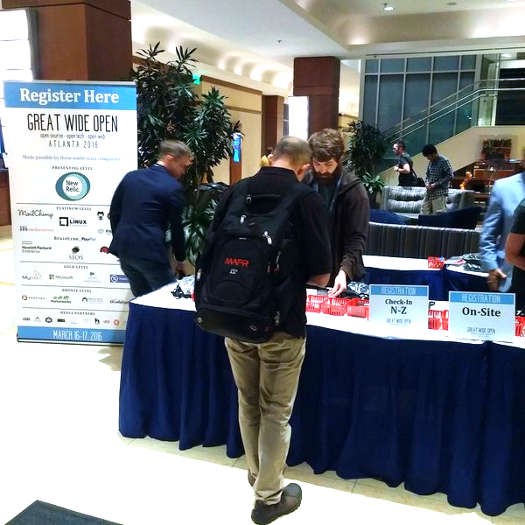
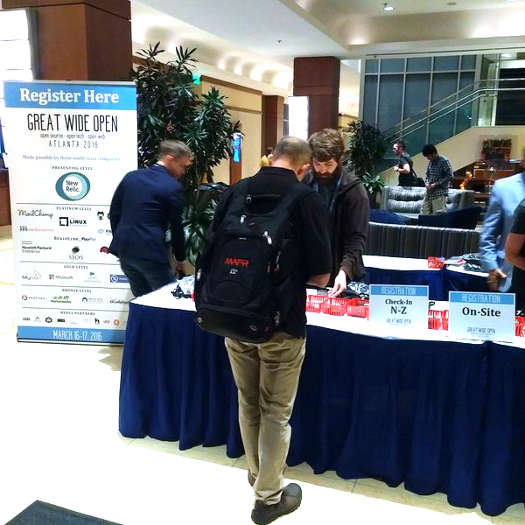
If there was ever an open source conference that doesn’t need any help from the press, it’s this year’s Great Wide Open in Atlanta. In spite of getting very little media attention, IT-oLogy, the nonprofit behind the event, was able to announce nearly two weeks ago that tickets to the second day of the two day conference were already sold out, with less than 200 remaining tickets for day one. Day one was Wednesday, and as logic would dictate, day two is today.
**If you’re finding this article useful, please consider helping us meet our absolute minimum daily goal of $16.29 so our FOSS Force Independence 2026 fundraiser stays on track.**
According to the time stamp, this pic was posted around 7 or 8 Wednesday morning by the Great Wide Open team. The conference has begun!
This comes as something of a surprise, as this isn’t an established conference with a history like, say, OSCON, SCALE or even All Things Open, which these days is probably the flagship event of the same IT-oLogy that’s putting on this show down in the land of magnolia blossoms.
Christine Hall has been a journalist since 1971. In 2001, she began writing a weekly consumer computer column and started covering Linux and FOSS in 2002 after making the switch to GNU/Linux. Follow her on Twitter: @BrideOfLinux
Ken Starks throws down the gauntlet and puts a hundred bucks on the line in an attempt to see if civility can be brought to the forums and a particular change made to LibreOffice.
It was last Wednesday that I dropped into one of the forums where I lurk on occasion and even on fewer occasions might post. One of our newer Reglue kids had emailed me with a question about something I’ve been teaching our kids for a while now, but even though I had explained this to her just a month ago, I had to ‘splain it to her again.
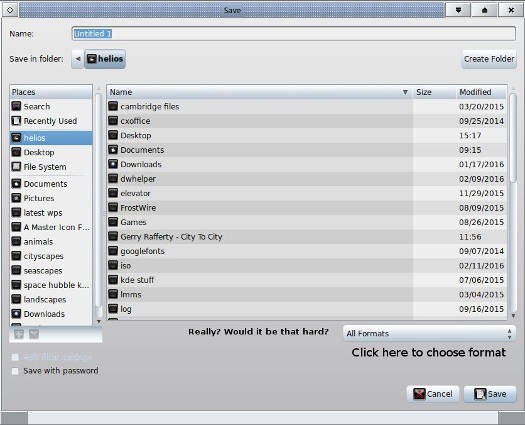
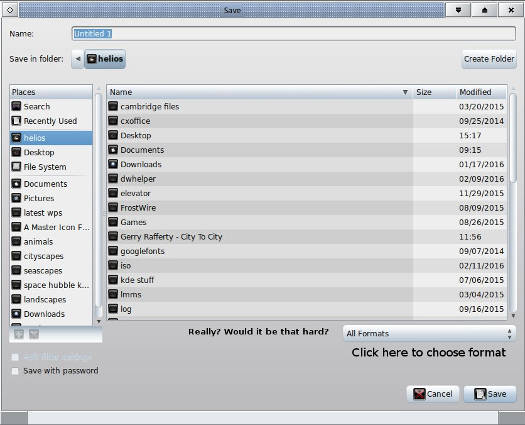
I had to remind her how to change the format in Writer before she sent her document off to a Windows user.
**If you’re finding this article useful, please consider helping us reach our absolute minimum daily goal of $16.29 today so our FOSS Force Independence 2026 fundraiser stays on track — any amount helps.**
Go ahead and roll your eyes, you who are all-knowing. It’s an easy thing for us, but I want those of you who care to see things through the eyes of a new Linux user.
Ken Starks is the founder of the Helios Project and Reglue, which for 20 years provided refurbished older computers running Linux to disadvantaged school kids, as well as providing digital help for senior citizens, in the Austin, Texas area. He was a columnist for FOSS Force from 2013-2016, and remains part of our family. Follow him on Twitter: @Reglue
Two big open source conferences are coming up next week, while this week an automaker said it doesn’t have to pay attention to the GPL and the man credited with inventing email passed.
Although Microsoft mainly succeeded in its attempts to hijack the FOSS news scene this week by spreading open source love — better than spreading FUD, I guess — there was plenty of FOSS news happening away from the Redmond campus. Even Microsoft with all its billions, it seems, isn’t large enough to monopolize all of the news in the big, wide and wonderful world of FOSS.
**If you’re finding this article useful, please consider helping us meet our absolute minimum daily goal of $16.29 so our FOSS Force Independence 2026 fundraiser stays on track.**
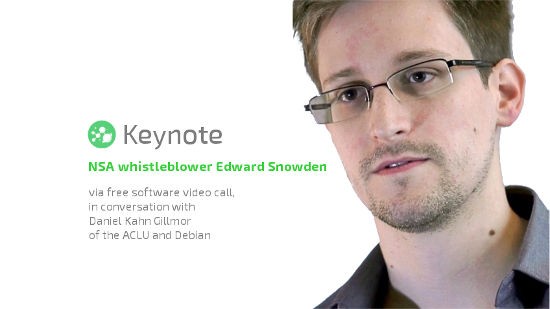
Edward Snowden will be the opening keynote speaker, with Daniel Kahn Gillmor, at LibrePlanet 2016.
For starters, it’s conference season. Well, except for a lull in the dog days of summer, Linux and open source conferences are always in season, but there are a couple of big ones on the slate for next week.
Christine Hall has been a journalist since 1971. In 2001, she began writing a weekly consumer computer column and started covering Linux and FOSS in 2002 after making the switch to GNU/Linux. Follow her on Twitter: @BrideOfLinux
Reglue continues to make a difference in Southeastern Texas with its New Hope Computer Technology Project.
It’s said that the wheels of progress turn slowly. That proves to be true to the nth when dealing with any kind of government. Be that as it may, things do happen eventually. This week is a shining example of what can be accomplished when a city and a private group band together for the common good.
**If you’re finding this article useful, please consider helping us reach our absolute minimum daily goal of $16.29 today so our FOSS Force Independence 2026 fundraiser stays on track — any amount helps.**
I am just bustin’-at-the-seams happy to announce The New Hope Computer Technology Project here in my small town of Taylor, Texas. After way too many meetings and committees formed to insure viability, Reglue is fully operational and in the midst of installing computers for people who need them most. To refresh memories here, The New Hope Computer Technology Project is named to celebrate the unselfish and giving doctors who treated my cancer, even when they knew I didn’t have a dime to spare.
Ken Starks is the founder of the Helios Project and Reglue, which for 20 years provided refurbished older computers running Linux to disadvantaged school kids, as well as providing digital help for senior citizens, in the Austin, Texas area. He was a columnist for FOSS Force from 2013-2016, and remains part of our family. Follow him on Twitter: @Reglue
India again shows sanity by doing away with “software only” patents, and the Linux Foundation continues to move towards diversity.
The old and the new both made big news on the FOSS front this week. Representing the old was what appears to be the ending of the SCO vs IBM case after something like 13 years, which means that Caldera/SCO now gets to go to its final resting place. For the new was the release of the Raspberry Pi 3, which comes wielding a 64-bit ARM processor with built-in Wi-Fi and Bluetooth.
But that wasn’t the only news of interest to the FOSS world this week…
**If you’re finding this article useful, please consider helping us meet our absolute minimum daily goal of $16.29 so our FOSS Force Independence 2026 fundraiser stays on track.**
Christine Hall has been a journalist since 1971. In 2001, she began writing a weekly consumer computer column and started covering Linux and FOSS in 2002 after making the switch to GNU/Linux. Follow her on Twitter: @BrideOfLinux
Tasks which are everyday simple to the experienced computer user can be daunting to someone who hasn’t been shown how.
Most everyone reading this, to at least some point, is computer proficient. Whether we’ve written scripts for macros to make our typing tasks simpler, or created entire websites, we perceive our skills as part of our daily lives. Not a big deal. It’s simply the tools we’ve accrued to facilitate our work. Ctrl+A? Nothin’ to it. Ctrl+V? Same same. Vi vs Emacs? Don’t start it. There are dozens of small, time-saving commands we’ve learned over the years. And we most certainly do take them for granted. But to those who don’t know much past turning the computer on and doing some basic browsing, those commands are like magic.
**If you’re finding this article useful, please consider helping us meet our absolute minimum daily goal of $16.29 so our FOSS Force Independence 2026 fundraiser stays on track.**
Ken Starks is the founder of the Helios Project and Reglue, which for 20 years provided refurbished older computers running Linux to disadvantaged school kids, as well as providing digital help for senior citizens, in the Austin, Texas area. He was a columnist for FOSS Force from 2013-2016, and remains part of our family. Follow him on Twitter: @Reglue
As Linux Mint scrambles to get security back on track, numerous prototypes of Linux phones are on display and Ubuntu gathers awards at the Mobile World Conference in Barcelona.
What a week in the FOSS world. So much has happened since our last Week in Review that I think I’ll skip the idle chitchat about the weather and such and get straight to business. Well, I will take the time to tell you that it’s been damned cold in these parts and I’m more than ready for spring…
The Great 2016 Linux Mint Hack: The hack at one of the crown jewels of Linux distros has undoubtedly been the biggest story this week. I’ll not bore you by repeating details which most of you have probably already read by now, but will direct those of you who don’t know to FOSS Force’s coverage on Sunday, and to our report on Monday in which Freedom Penguin Matt Hartley helps me take a look at the nature of the crack/hack.
**If you’re finding this article useful, please consider helping us meet our absolute minimum daily goal of $16.29 so our FOSS Force Independence 2026 fundraiser stays on track.**
The good news is that things are slowly — very slowly — returning to normal for the Mint team. By midweek, things were under control enough that the switch could be flipped on Mint’s server, putting the website back online. On Thursday I had a very brief email discussion with the distro’s project leader Clem Lefebvre — “very brief” because Lefebvre was more than little busy at the time. He and his team are in up to their elbows, working to make sure that everything works and plays well with the hardening they’ve done to Mint’s server, as well as working overtime to find any niggling security issues. In other words, they have it all under control, even as they work to get it more under control.
Christine Hall has been a journalist since 1971. In 2001, she began writing a weekly consumer computer column and started covering Linux and FOSS in 2002 after making the switch to GNU/Linux. Follow her on Twitter: @BrideOfLinux
After answering various calls for presentations to a few upcoming shows, it stands to reason that Tom Petty is right: The waiting is the hardest part.
**If you’re finding this article useful, please consider helping us meet our absolute minimum daily goal of $16.29 so our FOSS Force Independence 2026 fundraiser stays on track.**
Because I now use PC-BSD on a daily basis, the idea going forward is to pitch talks about the conversion from one side of the Free/Open Source Software street to the other; the uplifting situations and occasional hurdle such a conversion brings, and to outline the similarities (lots) and differences (few, but relatively significant) between Linux distros and BSD variants.
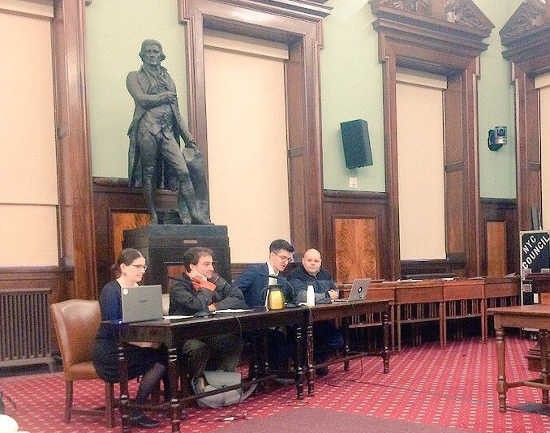
On Tuesday, representatives of four FOSS friendly agencies testified before a New York City committee considering bills that would mandate the use of FOSS by city government.
“Free and open source software has many advantages over proprietary software,” Karen Sandler, the executive director of the Software Freedom Conservancy, testified Tuesday before the New York City Council Committee on Contracts. “Studies show that, over time, free software is safer from vulnerabilities. Free software is auditable — security and functionality can be verified upon inspection. Anyone can independently assess the software and its risks. Developers can more easily and quickly repair discovered vulnerabilities or bugs (and bugs are very common in all software – the Software Engineering Institute estimates that an experienced software engineer produces approximately one defect for every 100 lines of code). Free software removes dependence on a single party, as anyone can make changes to their version of the software. And municipalities can hire any contractor on the open market to work on the software.”
**If you’re finding this article useful, please consider helping us meet our absolute minimum daily goal of $16.29 so our FOSS Force Independence 2026 fundraiser stays on track.**
Karen Sandler, executive director of Software Freedom Conservancy and others at Tuesday’s hearing before the New York City Committee on Contracts.She was speaking in support of two bills: the Free and Open Source Software Act, which “would minimize city contracts for proprietary software in favor of free and open source software that can be shared between government agencies and bodies,” and the Civic Commons Act, which “would encourage the collaborative software purchasing of free and open source software among agencies, cities and states to pool resources, avoid duplicated effort, create portable expertise, grow jobs, and reduce costs.” Both bills are sponsored by New York City councilman Ben Kallos, and both were originally introduced on May 29, 2014.
Christine Hall has been a journalist since 1971. In 2001, she began writing a weekly consumer computer column and started covering Linux and FOSS in 2002 after making the switch to GNU/Linux. Follow her on Twitter: @BrideOfLinux








 The Great 2016 Linux Mint Hack: The hack at one of the crown jewels of Linux distros has undoubtedly been the biggest story this week. I’ll not bore you by repeating details which most of you have probably already read by now, but will direct those of you who don’t know to