
The Apache-licensed project seeks to elevate independent sources, demote SEO spam, and ultimately loosen Big Tech’s grip on web search.
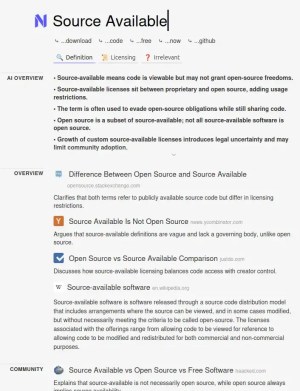
There’s a new budding search engine you can try called NeoSearch. It’s open source, licensed under Apache 2.0, with the full code available on GitHub.
“Anyone can read it, fork it, and run their own search engine with it,” Bart Jellema, the person behind the project, posted in a blog on the projects website.
You might want to wait before doing any serious forking or anything like that, however. Right now this is very much a project in its early stages. It works enough to be useful, but there’s not a lot of “there there” yet. Give it time and it’ll develop into something.
“I’ve been building NeoSearch for two years, mostly quietly, funding it myself,” he said.
Jellema has a track record. In 2007 he co-founded Tjoos, an online coupon service, which was acquired in 2010 by the US internet-media company Internet Brands. At the time of the acquisition, the startup reportedly had grown to more than a million unique monthly visitors, with over 500,000 coupons from more than 180,000 merchants. That same year, Jellema was named The Next Web Australia’s Startup Person of the Year.
To save some time and a lot of money, Jellema’s been building the project on Google’s index. He’s good with that decision, because he’s not convinced that the index is what needs fixing about search.
“NeoSearch starts from a different question: how much of what’s wrong with search is the index, and how much is everything built on top of it? My bet is that it’s mostly the latter. To test that, NeoSearch takes the top 20 Google results for a query and treats them as raw material.”
In other words, Google’s indexing is the crude oil that Jellema is seeking to refine into something useful.
“Every result gets assessed by AI for how commercial, official, or independent it is, and re-ranked accordingly,” he said. “Independent, authoritative sources move up. Affiliate listicles and SEO-farmed content move down. A result buried at position 20 on Google can end up first on NeoSearch, and regularly does.”
His plan is to build NeoSearch in three stages. If I’m reading his blog right, the first stage — “prove that a fundamentally better search experience is possible, using existing index data as the base layer” — is either near or at completion.

The next stage will be to crawl and blend into the results the parts of the web that the major search engines ignore. He lists these as independent blogs, forums, and personal sites. “This is where NeoSearch’s results start diverging from anything Google could show you,” he said. The final stage — “build toward an open, distributed search index” — is a little under defined, but according to Jellema, it’s where the meat connects to the bone.
“That last stage is the actual mission,” he said. “I don’t want NeoSearch to become the next search giant. I want search to stop being something only giants can do. If one day there are a thousand search engines running on an open index, each with its own ideas about ranking and interface, then this project succeeded, whether or not any of them is called NeoSearch.”
What he’s made available so far is useful. Perhaps not as useful in most ways yet as Google, Kagi, or duckduckgo — but maybe already more useful in some ways. Take a look and try it for yourself.
For the foreseeable future, he’s funding the project out-of-pocket, something he says he can continue doing “for a long time,” which I’m taking to mean for as long as it takes.
“Long term, the plan for sustainability is developer API access to our curated data, and clearly disclosed affiliate links that never, under any circumstances, influence ranking,” Jellema said. “I know how that last one sounds coming from an engine that down-ranks affiliate spam. The difference is disclosure and separation: ranking decisions and revenue must never touch. The code being open means you can hold me to that.”
Editor’s note: This project was brought to our attention by the project’s creator using our Contact Us form. Access to the form can be found just below our masthead on every page on our site.

Christine Hall has been a journalist since 1971. In 2001, she began writing a weekly consumer computer column and started covering Linux and FOSS in 2002 after making the switch to GNU/Linux. Follow her on Twitter: @BrideOfLinux


This is interesting. I like the idea of open source search. I wonder if a federated model could be developed so search becomes part of the internet’s inherent function. Maybe something in which every web server also has a component that some kind of search service in addition to serving up web pages.
In the same breath that claims to be free from big tech, then says you need APIs to the biggest tech of all. How does this loosen Big Tech’s grip when they can shut off that API access at any damn time, especially when it starts to subvert their money, power, or control.
I agree that the index in the not problem, however, I feel like you will need an independent index, maybe federated as Joe Beach posits, to really wrest control back from big tech.
Also, a scalable, reliable, and independent infrastructure will be necessary as well least the site gets shut off from the internet.