
These are the ten most read articles on FOSS Force for the month of January, 2016. 1. SourceForge and Slashdot Have Been Sold by Christine…

Posts published by “FOSS Force”

The FOSS Force Poll
Inquiring minds wanted to know, so we asked. When choosing what to run on a machine — we’re talking computing machines running GNU/Linux here — what’s more important, the choice of distro or which desktop environment to run? We began asking the question among ourselves several weeks back when we were running our “best distro” poll and a few commenters observed that the desktop might be a more important metric for most users, since it’s the desktop that supplies the interface with which the user interacts. Good point, we thought.
**If you’re finding this article useful, please consider helping us reach our absolute minimum daily goal of $12 today so our FOSS Force Independence 2026 fundraiser stays on track — any amount helps.**
So we put it to you in a poll that asked, “Which matters most to you: The GNU/Linux distribution you use or the desktop environment?” The poll went up on Sunday and on Monday we published an article introducing it. The poll concluded this morning, shortly after midnight EST.

The FOSS Force Poll
A couple of weeks back when we ran our two part GNU/Linux distro poll, a couple of commenters made a single point that, at first glance, seemed valid.
It’s not the distro that’s important to most users, they said, because most users don’t interact with the distro itself as they work and play on their Linux machines. Instead, the average user’s direct interaction with a computer is primarily through the desktop environment, whether that be KDE, GNOME, Unity or something they rolled on their own on a Friday night instead of having a boys’ or girls’ night out.
**If you’re finding this article useful, please consider helping us reach our absolute minimum daily goal of $12 today so our FOSS Force Independence 2026 fundraiser stays on track — any amount helps.**
In other words, they opined, it’s the desktop, and not the distro, which represents the operating system — or even the entire computer — to most users.

The FOSS Force Quiz
Are you a distro hopper? Are you one of those people who knows what day of the week it is because of which distro you’re using? If so, this quiz is for you. But even if you’re one of those people who finds a distro you like and sticks with it until it becomes as comfortable as a well worn shoe, you’ve probably done your homework, and that’s why you were able to find the distro that was a perfect fit for you. In other words, you’ll probably do well on our quiz too — because it just might be a tortoise and hare sort of thing.
Anyway, now it’s time to test your knowledge in our FOSS Force Linux Distro Quiz. There are 18 questions about 18 distros and it’s pass/fail; either you make the grade or you don’t. 70 percent is the magic mark. Go over, and you’re off to study for your Linux certification. Go under, and it’s back to seventh grade for you. After you’re through you can check your answers. Each answer you get wrong will be underlined in red and all the right answers will be underlined in green.
**If you’re finding this article useful, please consider helping us meet our absolute minimum daily goal of $12 so our FOSS Force Independence 2026 fundraiser stays on track.**
And yes, this does count toward your final grade and will go on your permanent record. And no whining about questions being unclear. We’re the teachers. We’ll decide whether the questions are clear or not…

The FOSS Force Poll
The voting is all done for the second round of our poll to decide which GNU/Linux distro our readers would choose to receive our “Reader’s Choice Best Linux Distro” award for 2015. As in round one, Arch Linux won the day. The poll results are considered to be more a measure of a distro’s community support than any indication of a distro’s technical merits.
**If you’re finding this article useful, please consider helping us meet our absolute minimum daily goal of $12 so our FOSS Force Independence 2026 fundraiser stays on track.**
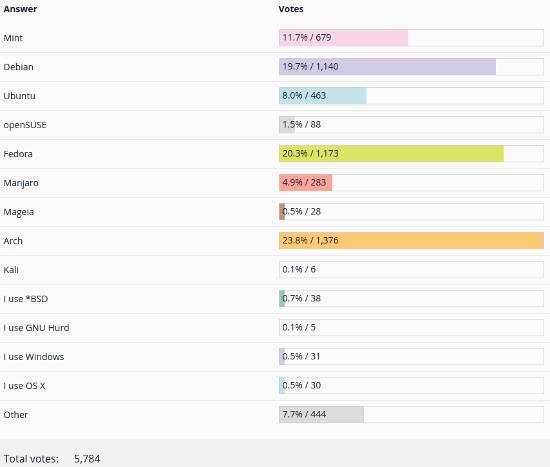
The first round of our poll was a qualifying round, which Arch won as well, racking up 1,376 votes. The second round of voting was “winner take all,” and with the voting lighter than in the first round, Arch still managed to put together 592 votes. In all, 2,625 votes were cast in round two, which was active for seven days.
So you think you know your Linux history, eh? It’s time to put on your thinking cap and find out whether or not that’s true.…
The FOSS Force Poll
The voting is over in the first round of our annual GNU/Linux distro poll, which sought an answer to the simple question, “What Linux distro do you currently use most?” The result was a complete surprise, at least to us. By a decisive margin, you voted for Arch Linux. The poll was certainly one for the record books. By the time it was closed to voting, a total of 5,784 of you had cast votes, more than double from any previous FOSS Force poll. The poll was online for approximately one week.
**If you’re finding this article useful, please consider helping us meet our absolute minimum daily goal of $12 so our FOSS Force Independence 2026 fundraiser stays on track.**

We’re going to pretend like we’re AM disc jockeys from the golden days of top 40 radio and countdown the top nine stories that appeared on FOSS Force last year. Along the way, we’ll offer a bit of commentary, and maybe remind you a time or two that things were much different way back in 2015.
**If you’re finding this article useful, please consider helping us meet our absolute minimum daily goal of $12 so our FOSS Force Independence 2026 fundraiser stays on track.**
The FOSS Force Poll
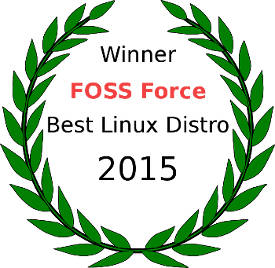
It’s time for our annual “What’s Your Distro” poll, to determine who gets the FOSS Force Best Distro Award for 2015. This year we’re pulling out all the stops. We want this one to be a metaphoric old fashioned slug fest that will be played until only one distro is standing.
**If you’re finding this article useful, please consider helping us reach our absolute minimum daily goal of $12 today so our FOSS Force Independence 2026 fundraiser stays on track — any amount helps.**