
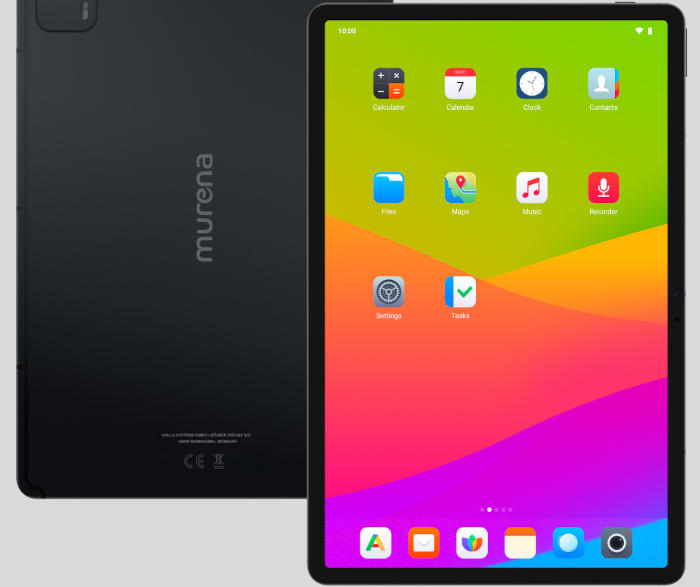
Paris‑based Murena and Germany’s Volla are teaming up on a tablet for people who want Android hardware without Google’s software.
Posts tagged as “tablet”
First my FOSS predictions for 2015: cloud, systemd, vulnerabilities, containers, and Linus uses the “F” word.
Let’s forget predictions; they’re boring. They’re either too obvious or they’re not likely to happen. So is my wish list, with two major exceptions. First, wishes are much more subjective, making them much more fun for the wisher. Second, when predictions don’t happen, they’re wrong. When I wish for things and they don’t happen, they’re still things I wish for, so they’re not wrong, they’re just not happening. Caution must be exercised, however. Remember the old proverb ascribed to the Chinese about the possibility of wishes coming true…
** If our coverage matters to you, please consider supporting our work through our FOSS Force Independence 2026 fundraiser. **
Oh, one last thing about how I wish. Sometimes I wish in very great detail. My friends who believe in magic tell me this is good, that it will help bring my wishes to fruition. Time will tell. Stay tuned…

Christine Hall has been a journalist since 1971. In 2001, she began writing a weekly consumer computer column and started covering Linux and FOSS in 2002 after making the switch to GNU/Linux. Follow her on Twitter: @BrideOfLinux
And the hits just keep on coming…
Today’s float on the parade of the PC-is-dead prognostications comes from The Register, which says, “At the very moment that Linux desktops seem to be reaching new levels of sophistication, polish and ‘just works’ ease-of-use, the entire future of the desktop computer (by which I also mean laptop) feels in doubt.”
The only thing that’s in doubt is whether that sentence is anywhere near remotely accurate. But let’s put that aside for a moment and assume we can see the future of how we deal with our digital lives.
**
If you're finding this article useful, please consider supporting our work through our FOSS Force Independence 2026 fundraiser.
**
Sure, you can see a Post-PC future from here all right. Of course, you’re going to need the Hubble to do so.
Naturally, there are things that you can do with your Post-PC apparatus, like surf the web, watch videos and all those important digital activities. But bear in mind that you’re not going to be using Blender on your smartphone.


First things first: I’m not heavily invested in GNOME. In fact, once GNOME 3 came out and — gasp! — no icons on the desktop, I said “vaya con dios” and made skid marks racing to Xfce, KDE and Openbox (on the CrunchBang box) on various machines in the lab. The reason is a matter of personal taste. For the most part, I like icons on my desktop, not in a tray on the side, and I like what they do when I click on them — like, you know, open programs.
But this is not to say I haven’t used GNOME lately. In a test drive on Sunday of Fedora 21 Workstation (that’s GNOME, for those of you keeping score at home), I was reminded why GNOME was not my personal favorite. Exhibit A: I have a tendency to amass large numbers of different copied material to which I often return from time to time — not a huge deal with Klipper in KDE or Clipman in Xfce. But in the current GNOME 3-point-whatever, the clipboard is being managed way behind the scenes, and that doesn’t work for me.
**
If you're finding this article useful, please consider supporting our work through our FOSS Force Independence 2026 fundraiser.
**
 Let me be clear, for those GNOMEistas who might just have their proverbial knickers in a bunch: GNOME has been a remarkable FOSS citizen providing a better-than-adequate desktop environment for many FOSS users, perhaps even a majority of FOSS users. I just don’t happen to be one of them. Further, I will say this for GNOME: Unity should be more like GNOME. Compliment? You decide.

FOSS Week in Review
NSA involved in industrial espionage
Another big non-surprise this week in the continuing saga of the NSA. It appears that our beloved spy agency has been using their secret powers for the purpose of uncovering industrial secrets from foreign companies. So much for the separation of business and state. Reuters reported that in a television interview with a German TV network, Edward Snowden said the agency doesn’t confine its intelligence gathering to items of national security.
**
If you value this kind of coverage, please consider supporting our work through our FOSS Force Independence 2026 fundraiser.
**
“‘If there’s information at Siemens that’s beneficial to U.S. national interests – even if it doesn’t have anything to do with national security – then they’ll take that information nevertheless,’ Snowden said…”
Even the Republicans are jumping on the stop-the-NSA bandwagon, which is rather surprising.

FOSS Week in Review
In 2013, Linux hits grand slam
Now that companies are closing-out their books on the old year, it’s becoming evident that Linux devices were a big hit in 2013.
** If our coverage matters to you, please consider supporting our work through our FOSS Force Independence 2026 fundraiser. **
On Friday, CNET’s Brooke Crothers reported that Chromebooks, those nifty laptops running Google’s Chrome OS that let the cloud do the heavy lifting, accounted for 21% of all laptop sales last year. As impressive as that may be, the numbers get even better when Android tablets are added to the mix. According to market research company NPD Group, January to November saw 1.76 million Chromebooks and Android tablets sold, up from only 400,000 during all of 2012.
The OEMs, of course, are paying attention and are readying new Linux devices for the market.

FOSS Week in Review
NSA: Locking the barn door after the horse is stolen
**
If you're finding this article useful, please consider supporting our work through our FOSS Force Independence 2026 fundraiser.
**
On Monday, Reuters reported in an exclusive story that the NSA had failed to install some super duper software meant specifically to protect the agency from inside threats at the site in Hawaii where Eric Snowden downloaded thousands of classified documents. In other words, after spending who knows how much taxpayer money developing internal security software, made by Raytheon by the way, and getting it installed and tweaked at NSA installations everywhere, little Eric Snowden was shuffled off to one of the only, if not the only, locations where internal security wasn’t in place. In hindsight, this made the NSA akin to two lengths of case hardened steel chain being bound together by a link made from a paper clip.
FOSS Week in Review
Adobe hacked
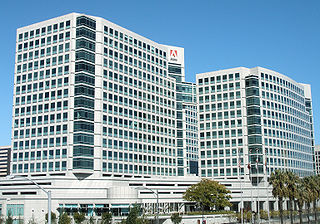
We’ve known for years that Adobe doesn’t seem to have a knack for keeping their products secure. New vulnerabilities are found almost daily in Reader and Flash, so much so that Windows users grow used to the constant updates required of them by the fine folks at Adobe. Now it appears as if the San Jose based company can’t keep their servers secure either.
** If our coverage matters to you, please consider supporting our work through our FOSS Force Independence 2026 fundraiser. **
Last Friday, The Australian reported that black hats had managed to steal source code and sensitive customer information:
Microsoft is trying to get a grip.
They’re not in a tailspin, nothing like it, not yet anyway, but they haven’t had a vision since the release of Windows 95. They’ve had success that wasn’t visionary, the Xbox comes to mind, but that was a calculated move for market share, not a vision for the company’s future. They also helped pioneer the tablet, Bill Gates personal vision around the turn of the millennium, but they couldn’t figure out how to implement it.
**
If you're finding this article useful, please consider supporting our work through our FOSS Force Independence 2026 fundraiser.
**
 We’ve seen this crisis coming since the introduction of Vista, which should have been a shining moment for the company. After all, the operating system was nearly six years in the making. They botched it, releasing a much anticipated OS that was not only a resource hog but basically just didn’t work. Wow. This was just after the release of Zune, a “me too” iPod, and before the release of the Kin phones, which are so rare that they probably fetch a premium on eBay.